For all the birders (and everyone else!)
The newer entries are all under Nono.
COTOPAXI
Andean Lapwing
Andean Teal
Andean Gull
MINDO
Quetzel
Cock-o-the-Rock
White-capped Dipper
Masked Trogan
Golden Olive Woodpecker
Cinnamon Peccard
Squirrel Cuckoo
Choco Toucan
Ornate Flycatcher
Black-cheeked Woodpecker
Wood Creeper
Spotted Wood Creeper
Palm Tanneger
Lemnon Rumped Tanneger
Nono
Rufous-collared sparrow
Southern Yellow-grosbeak
Rufous-naped brush-finch
Glossy Thrush
Tropical Kingbird
Sword-billed Hummingbird
Tropical Mockingbird?
Cinereous Conebill
Black-tailed train-bearer 9-19-2010
Monday, September 27, 2010

Changes
7 months in Ecuador. Almost a year spent in a foreign country. The first five months of my life as a Peace Corp volunteer were spent in constant transition, moving first from the (relatively) flat and english speaking state of Nebraska to the mountainous and spanish speaking country of Ecuador, then from hostals to houses and back to hostals again; saying goodbye to my warm winter fleeces only to unpack them a month later, moldy and smelling of my concrete room in the coast. Though I can´t describe my life now as normal (though in reality, there is no such thing as a normal life), the pace has slowed, and routines are developing. I can take time to celebrate and appreciate the small changes, which is something I had not quite mastered when living stateside. So, I am unofficially dedicating today, September 27,to the small things of life.
ST #1: My kitchen is finally painted! After three months of dirty white and moldy green walls, I came home after a weekend away to find my kitchen had been transformed into what appeared to be the inside of a peach. It´s quite cheering to eat breakfast in every morning, especially with the slug trails gone (albeit temporarily).

ST #2: I have a garden. Though I did enjoy pottering about in the yard and flower gardens in Nebraska, my passion never did equal that of my mother, who produces colorful and abundant gardens every spring. My landlady loaned me a strip of dirt to experiment with, and after she saw how the seeds I planted actually grew and have the promise of flowers, she ceded all of her yard to my garden whims. Now some of my favorite parts of the day are spent in the garden, weeding and watering and waging war with the slugs. It´s very therapuetic.

ST #3: My roof doesn´t leak anymore. Which is important, since I live in a region where the rainy season lasts nine months of the year, and even in the ¨dry¨ season it rains about twice a week. I do feel I should point out that during the process of replacing the roof, specifically when the old roof had been demolished and the new roof was not yet up, it poured buckets, which unfortunately found its way to my bed.
ST #4: Her name is Samina (after the famous Ecuadorian painter Guayasamin), she´s ten months old, likes to give high fives, and won´t sleep past 6 am. I originally wanted to call her Quetzal, but none of my Ecuadorian neighbors can pronounce that, so Samina it is. She´s small, but that doesn´t mean she represents a small change in my life. In fact it´s quite the opposite.

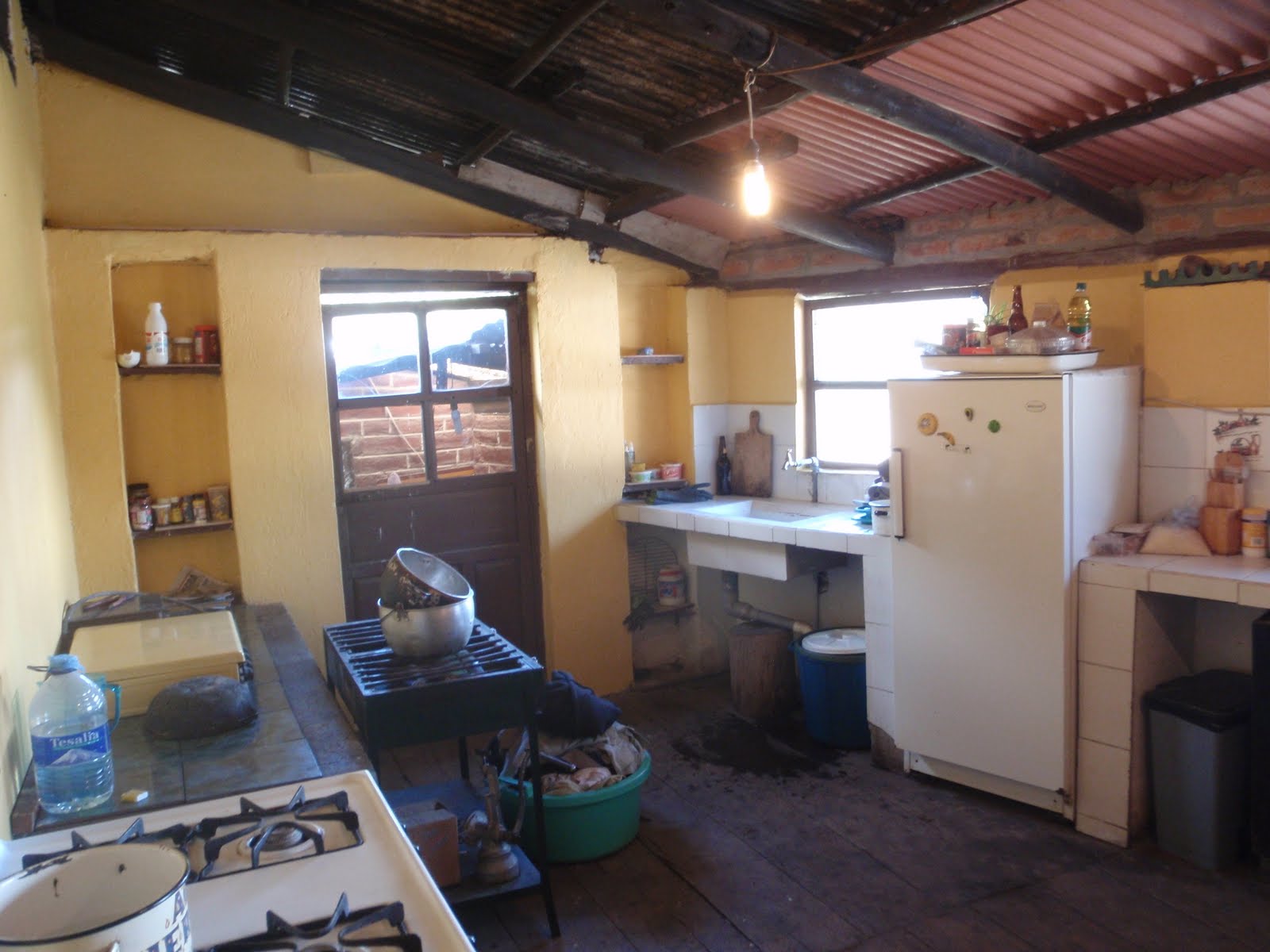
ST #1: My kitchen is finally painted! After three months of dirty white and moldy green walls, I came home after a weekend away to find my kitchen had been transformed into what appeared to be the inside of a peach. It´s quite cheering to eat breakfast in every morning, especially with the slug trails gone (albeit temporarily).
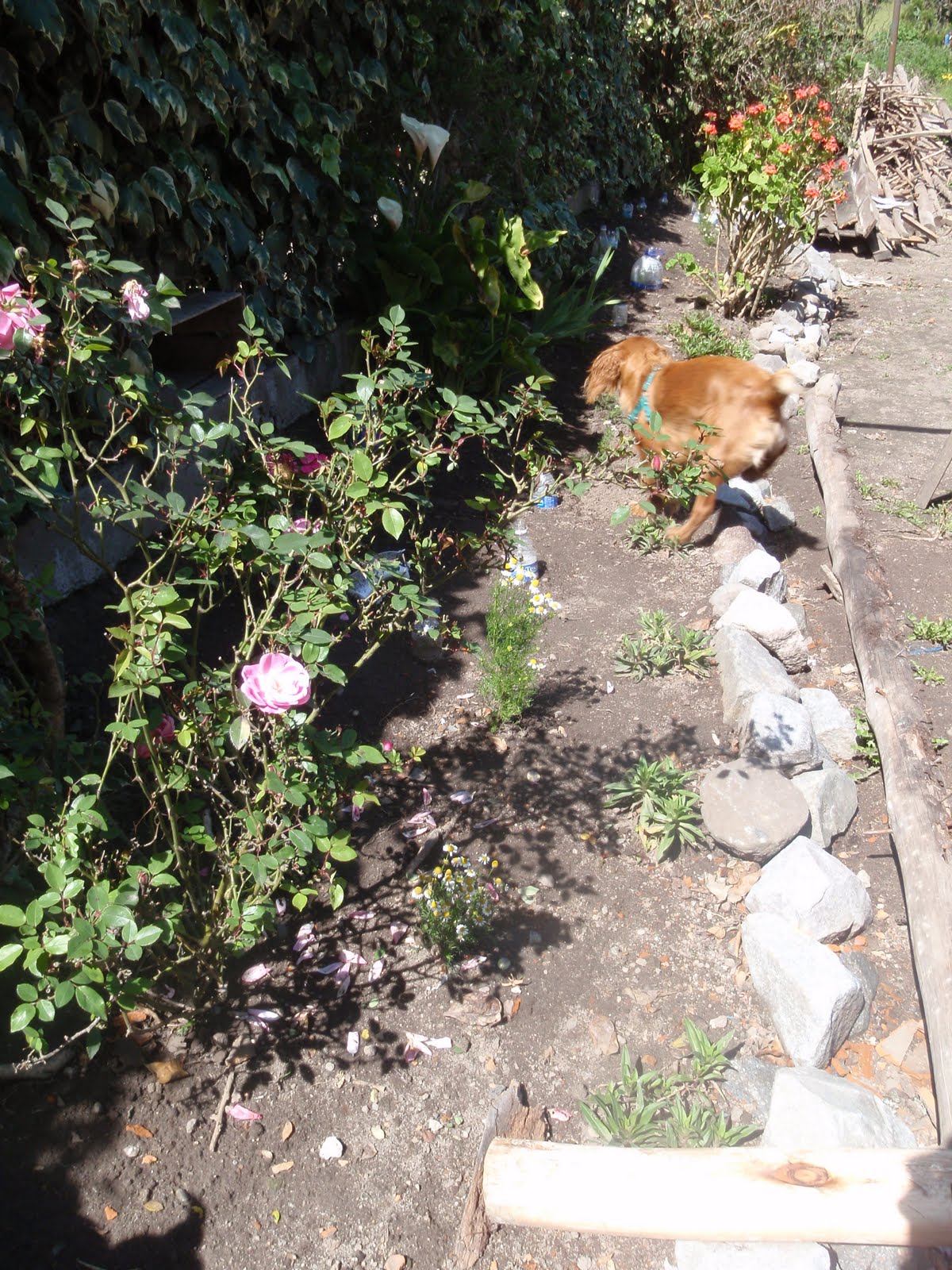
ST #2: I have a garden. Though I did enjoy pottering about in the yard and flower gardens in Nebraska, my passion never did equal that of my mother, who produces colorful and abundant gardens every spring. My landlady loaned me a strip of dirt to experiment with, and after she saw how the seeds I planted actually grew and have the promise of flowers, she ceded all of her yard to my garden whims. Now some of my favorite parts of the day are spent in the garden, weeding and watering and waging war with the slugs. It´s very therapuetic.
ST #3: My roof doesn´t leak anymore. Which is important, since I live in a region where the rainy season lasts nine months of the year, and even in the ¨dry¨ season it rains about twice a week. I do feel I should point out that during the process of replacing the roof, specifically when the old roof had been demolished and the new roof was not yet up, it poured buckets, which unfortunately found its way to my bed.
ST #4: Her name is Samina (after the famous Ecuadorian painter Guayasamin), she´s ten months old, likes to give high fives, and won´t sleep past 6 am. I originally wanted to call her Quetzal, but none of my Ecuadorian neighbors can pronounce that, so Samina it is. She´s small, but that doesn´t mean she represents a small change in my life. In fact it´s quite the opposite.

Saturday, August 28, 2010
Birds!
For all the birders (and everyone else!)
COTOPAXI
Andean Lapwing
Andean Teal
Andean Gull
MINDO
Quetzel
Cock-o-the-Rock
White-capped Dipper
Masked Trogan
Golden Olive Woodpecker
Cinnamon Peccard
Squirrel Cuckoo
Choco Toucan
Ornate Flycatcher
Black-cheeked Woodpecker
Wood Creeper
Spotted Wood Creeper
Palm Tanneger
Lemnon Rumped Tanneger
NONO
Southern Yellow-Grosbeak
Rufous-naped Brush Finch
Rufous-collared Sparrow
Glossy Black Thrush
Lots and lots of hummingbirds...still trying to figure out the species. Could somebody send me binocs? =)
COTOPAXI
Andean Lapwing
Andean Teal
Andean Gull
MINDO
Quetzel
Cock-o-the-Rock
White-capped Dipper
Masked Trogan
Golden Olive Woodpecker
Cinnamon Peccard
Squirrel Cuckoo
Choco Toucan
Ornate Flycatcher
Black-cheeked Woodpecker
Wood Creeper
Spotted Wood Creeper
Palm Tanneger
Lemnon Rumped Tanneger
NONO
Southern Yellow-Grosbeak
Rufous-naped Brush Finch
Rufous-collared Sparrow
Glossy Black Thrush
Lots and lots of hummingbirds...still trying to figure out the species. Could somebody send me binocs? =)
The Parentals Visit Ecuador

“It’s like you live in a musem! The old wooden floorboards, the holes in the windows, the doors themselves…”
“I know. I´m part of a living history museum!”
My parents and I were sitting at my kitchen table, enjoying large mugs of hot tea while trying to keep warm from the cold breeze that filtered through the gaps in the window and doors. It had been just one day since we had arrived in my town, after spending two days in Quito. Having my parents actually step foot in the house where I had lived for one month, and where I would be living for the next two years made my experience here more concrete, and I knew that this was real, that I was acutally living in Ecuador, and not just dreaming the whole thing.
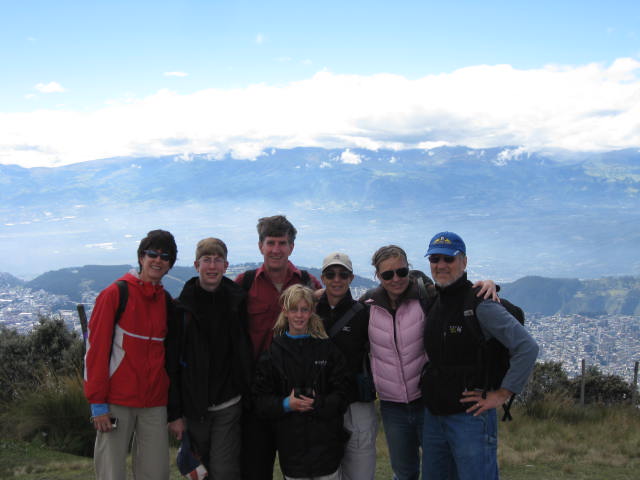
My parents had arrived in country three days before, after 12 hours of flying and waiting in airports. I couldn’t believe they were actually here… the anticipation for this moment had made the past month, and especially the past week, pass by at the speed of one of the slugs that habitually takes an evening stroll around my kitchen every night. Five months had passed since I waved goodbye from the Omaha airport, and they looked exactly the same, though slightly more disheveled given their journey. However, one night´s rest proved enough of a recovery, and in typical Thacker-Lynn fashion we climbed, amid sleet and wind and not even a full day after arriving in Ecuador, the highest active volcanoe in the world: Cotopaxi. This was achieved with the company of the Hammers, a family of four who had coincidentally planned a tip to Ecuador at the same time as my parents.

As their 13 year old son bounded up the steep slope as if it were nothing, I realized that at 24 I was not in peak physical form. This was reinforced four days later while I wheezed my way up an interminable hill while my parents appeared as if they were out on a Sunday stroll to Diary Queen. But that week I had little time to dwell on my lack of fitness. We biked dirt roads winding through the Andes mountains,

we discovered the delights of street food,

we waded in water flowing from the glaciers of the high Andes peaks while watching Quetzals fly among the cloud forests of Mindo,

we wandered among families enjoying the sunshine in the parks of Quito,

we enjoyed the generosity of my neighbors in the form of a plate full of choclo, habbas, mellocos, and aji.


>
And as we watched Nono disappear behind the mountains from the window of our bus (while trying not to watch the dropoff just inches from our bus wheels), we wondered at the inconsistency of time. Those moments when you just want to put on the brakes are when time throws you a grin and shifts up a gear, usually without letting you put on your seatbelt first. One minute you´re waiting at the airport anticipating the week ahead, and the next you´re standing in a Quito street in your pajamas, watching the taxi carrying your parents drive away. But you have a camera full of memories, proof that in that blink of an eye was time well spent.
 >
>


Monday, July 19, 2010
In the summertime, when the weather is.....cold?

We ambled along country roads under a bright sun, enjoying the warmth while we could, knowing that around noon heavy gray clouds would rise over the peaks, blotting out the sun and bringing with them a chill and sometimes rain. I walked with the director of the school, Margot, also my housemate, in the last group of kids. As usual, we had planned to leave around nine, but when I arrived at the predetermined hour of 8:30 Margot was in the middle of an interview with a local official, which didn’t end until well after our scheduled departure time. But the kids didn’t mind the wait, taking advantage of the sun and unsupervised time to behave, like, well, kids. Most of the girls broke into their specific groups, giggling and whispering, while the boys started a pickup game of soccer.
The ages of the kids on the hike ranged from 7-15, so naturally our pace was suited to those with smaller legs. After two hours of winding our way through the mountains on what is the main road from my town to the nearest city, but is still a narrow dirt track, I began to wonder how much farther our destination lay. Though the kids were infused with that “last-day-of-school” verve, the uphill climb was taking its toll, and we had evolved from three distinct groups to a long string of humans. However once we had reached the abandoned brick ovens, which overlooked a small stream flanked on the opposite bank by a hillside farm, everyone was magically infused with new energy and the kids scattered to clamber over the rocks and splash in the stream.
An hour later, surrounded by the remnants of 50 lunches (chicken bones and rice kernels), Margot sent one of the older girls on a mission to collect some cookies as a gift for the children from the farm across the stream. One immediately became two, and as the girls made their rounds the delivery duo soon became a mob. Students cheerfully handed over their government issued “healthy” cookies, then joined the group as it traipsed over the bridge and up to the mother, or grandmother ( it’s hard to tell sometimes), who had stopped in the middle of feeding the pig to watch the procession. I watched as the colorful and energetic students surrounded the woman, who was draped in old and worn shawls, her face a web of wrinkles from years of working in the elements. A bag of plastic wrapped cookies was exchanged for two sky blue farm eggs, then the two worlds separated, one to enjoy the last day of school, the other to a basket of clothes needing to be hand washed and cows needing to be milked.

Clouds had covered the sun and were threatening rain when the students slowly began to wander back from their various activities, some with wet hair and damp clothes from swimming in the stream. I opted to keep my fleece, scarf, and wool socks on and dry. We made our way slowly back down the road to meet our ride home, a small bus only slightly larger than a minivan. The teachers and students were unconcerned by the size (or lack thereof) of our transport, packing all 60 people into every available space like professionals. I had two kids on my lap, the driver had a kid on his lap, and three of the teachers hung out of the door. From the outside it appeared as if the bus was sprouting humans, and as I sat there pinned between two people I was reminded once again that I was most certainly not in the United States anymore. It took us nearly the same amount of time to return, due to the frequent stops we took to let students squeeze their way through the crowd to burst out of the bus, slightly dazed and with a chorus of voices to send them on their way home. By the time we reached my house the sun was behind the mountains and I could breathe again.
The next day Margot and her niece left for their hometown until September, leaving the house a little emptier and my evenings a little lonlier. But at least there won't be more wild bus rides in my near future...I hope.
Wednesday, June 30, 2010
New Digs: Part II

Electronic beeping pulls me from a dream involving lots of snow, and I blindly grope around my pillow for my phone, randomly pressing buttons until the noise stops. I turn over and curl up again under my heavy blankets, savoring the warmth for a few more minutes. When I open my eyes I can see beams of light streaming through the chinks in my door and single window. Knowing I won´t have the willpower much longer to get out of bed, I throw off the covers and hop over to the light switch. Changing into running clothes, I open my door to bright sun and a town already awake. The run up the mountain is painful, but the view at the top and downhill descent are well worth my sore muscles. A hot shower followed by a steaming cup of coffee (sadly, instant. Quality coffee is hard to come by here in Ecuador. Go figure.) complete my morning routine.
Sound like a typical morning in the coast of Ecuador?
No?
Well, that´s because it isn´t.

Wait a second, you say, wasn´t the plan to spend the next two years enjoying the beach and sun? It was, until an unfortunate incident caused the evacuation of all of the volunteers in my area, and a change of site for me. In a matter of two days I found myself temporarily homeless in Quito, with a hastily packed suitcase and the knowledge that I would probably never see my host family or new friends again. After two longs weeks in Ecuador´s capital I found a new home: high in the Andes and as cold as the coast is hot. Hello again to fleeces (slightly moldy and musty after a month in storage), Spanish I can actually understand, and the campo shuffle.
In my new home I don´t live with a host family. Instead, I share an old house with the director of the local school and her two year old daughter.

My bedroom is downstairs, she sleeps upstairs, and we both share a kitchen and bathroom with the father of our landlady (whose house this used to be until his wife died and he became too frail to live on his own), who you can find shuffling slowly around the property on his crutches. He and I apparently have the same schedule, and you can bet that when I need to use the bathroom it´s already occupied. I think he shaved for about two hours yesterday, emerging from the bathroom only when I had given up hope of a shower before catching the bus to Quito.
The kitchen is outfitted with a full size fridge, oven and stove, microwave, toaster, and plenty of counter space, which I put to good use as I spend a ridiculous amount of time cooking, baking , and listening to world cup games on an ancient radio. One perk of living independently is the ability to make my own food (adios to white rice three times a day!),which has been a source of amusement and curiosity on the part of my landlady, who usually finds the time to drop by during breakfast or dinner to see what´s cooking.Starting over in a new site is tough, and I´m still in the process of once again convincing myself that I can live and work for the next two years in my new home, which not only differs climatically from the coast but culturally as well. My month at my old site taught my at least one thing, which is what to expect those first few weeks on my own in an unknown place!
Sunday, May 16, 2010
New digs

Last week I had a tarantula in my room. Yes, a real tarantula. It was obese, hairy, and gave my host sister a heart attack when she pulled the blue flannel curtain away from my window. After admiring the giant arachnid and persuading it to return to the wild (with a coat hanger and two hysterical eleven year olds), I thought about my visitor and how this was just one indication out of many that my life does not resemble the being it was six months ago.
Or even one month ago. Days spent in language, tech and safety classes and nights spent under three or four blankets are now days spent playing Marco Polo in the river with local kids, teaching impromptu classes at the local school, or helping the locals construct a “galpon” (or chicken coop) while nights are spent under nothing but a mosquito net. The Spanish here is an altogether different beast than Sierra Spanish, the most noticeable difference being that the folks here drop the ends of words and talk like they’ve just injected caffeine into their veins, and I feel like I’m back in my eighth grade Spanish class. I can get by pretty well with just smiling and nodding, though that only works about 75% of the time. When there’s a longer pause than necessary in the conversation it’s usually because somebody asked me a question and is waiting for an answer. Then I’m in trouble.

With the structure of training gone my days are varied and filled with “unexpected’s”. I never know if the teacher will disappear for an hour in the middle of the class I am visiting, leaving me with 10 energetic 7-11 year olds (tip: books and markers are life savers! ). Or I might get lucky walking the hour to the bus stop and catch a camioneta…though when the weather is cool walking is preferable, and if I’m even luckier I could catch a glimpse of the howler monkeys that frequent the trees along the road. I could wake up one morning to a week of no electricity or running water. Though even this has its benefits, since without electricity I wouldn’t have experienced the most stunning firefly display of my life. Some days I come home to find the grandkids Nidia, four, and Jonah, six months, waiting at the door (well, just Nidia), and Nicol (the 11 year old sister of Nidia who lives with us permanently), Nidia and I go down to the river to play Marco Polo with the local kids. Last night Bernadina asked me if I wanted to take a walk with her, and before I knew what had happened I was sitting in a living room with several strangers singing to the Virgin Maria.

A little background about my site: it’s a small coastal community comprised of about 300 people who farm, raise cattle, or fish for a living. The community is divided into three parts: comunidad abajo, media, and arriba (lower, middle and upper). I live in the middle.
As before I live with six other people, and share one bathroom, though this arrangement is easier because we have the river, which is quite enjoyable for a wash or swim. My host family consists of my host parents, three brothers and one sister (though she’s actually my host niece), two dogs (down from seven. We had puppies!), and one unbelievably tiny cat which I’m surprised has lasted this long. There is running water, though it's pumped directly from the river, so we either boil it before drinking or drink bottled water. I eat rice three times a day, supplemented by beans, shrimp, platanos (fried green bananas), fish, chicken,sometimes vegetables, and always accompanied by coffee, tea, or juice.
But, like the Sierra, the people are warm, friendly, and welcoming. They love to share food and conversation (I can just share the food at this point). For the next two years I hope to be doing the same!

Subscribe to:
Posts (Atom)